
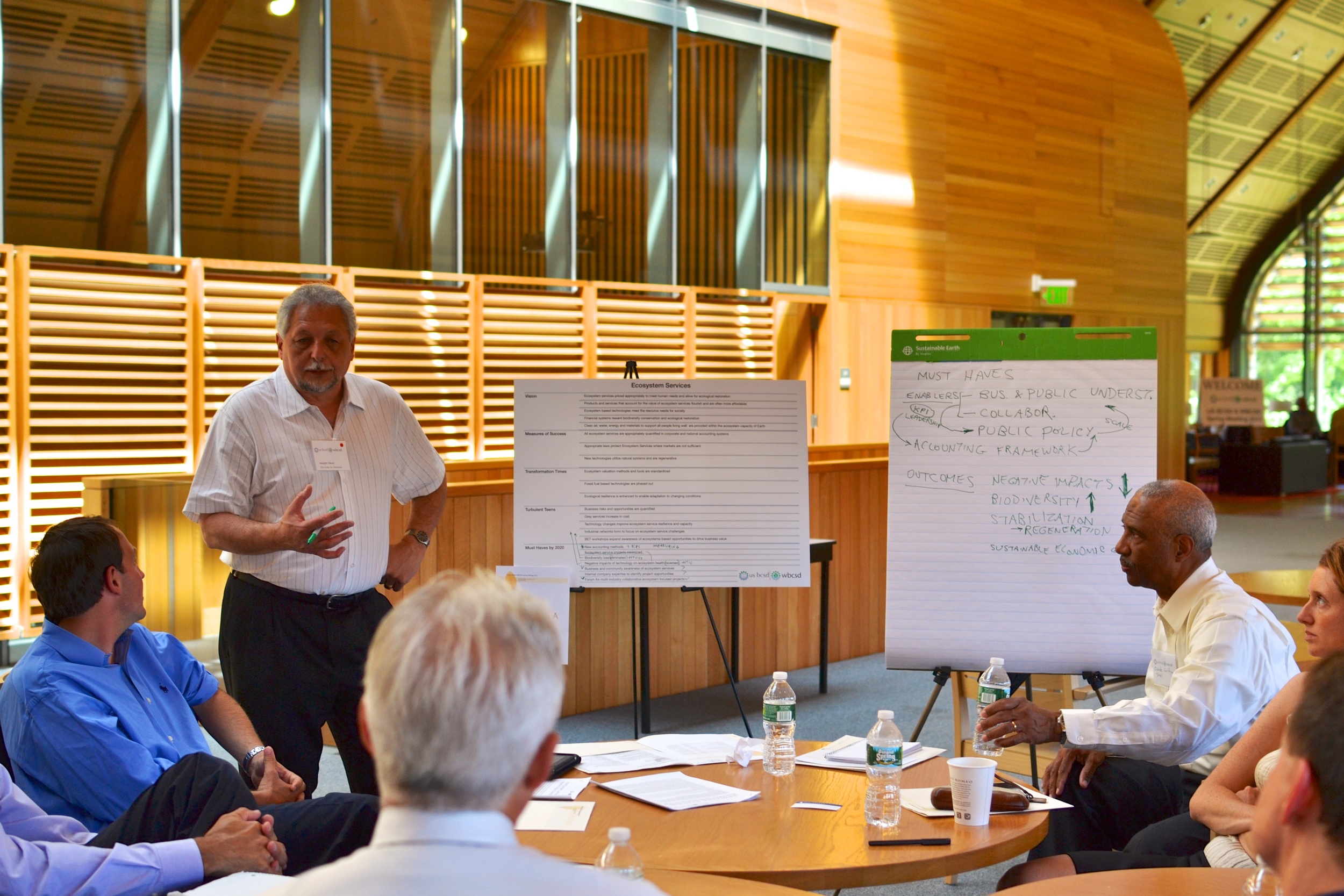
What’s helping us achieve a sustainable world and how do we scale it, brought close to 100 US BCSD and WBCSD members, government, academic and NGO colleagues, and other sustainability thought leaders to Yale University's Center for Business and the Environment on June 27-28, 2012. The working agenda stressed collaboration first and foremost in defining directions to reach a sustainable world in which nine billion people can live well and within the planet’s resources by 2050. Meeting attendees worked on partnerships, synergies and productive work outcomes that combined US BCSD regional implementation strategies with the WBCSD’s global Vision 2050 sustainability pathway. Over two days, attendees discussed examples of successful activities already under way to achieve Vision 2050 “must haves” and sought out ways to help articulate, acknowledge and scale those activities. They then joined forces in an innovation workshop aimed at seeking out and encouraging step changes towards the Vision 2050 in the US. Interspersed in this engaging group discussion were presentations and panels from sustainability thought leaders focusing on new financing mechanisms, organizational design, new collaboration opportunities, and examples of groundbreaking innovations highlighted in the breakout group pages below.
Thanks to everyone who made it to Yale University for our joint US BCSD and WBCSD-US Spring Meeting 2012. The meeting was a resounding success; and we're excited about the new innovations, connections, and momentum we'll be able to carry into our regional sustainability efforts going forward. Look for a full meeting summary, video content, photos and stories to be posted shortly.
As part of our ongoing webinar series, the US BCSD and partner BrownFlynn are pleased to bring you this webinar on the topic of water, recorded on May 23rd. This webinar discusses the impacts of water consumption and conservation in various locations, and the associated risks and opportunities.
Featured panelists include:
- Karl Fennessey, Director of Sustainable Development, ConocoPhillips
- Mary Parke, Manager, Integrated Water Services, Layne Christensen
- Jon Radtke, Water Resource Sustainability Manager, Coca-Cola North America
- Moderated by: Susan Fernandes, Director of Operations, US BCSD
Listen to our expert panelists discuss their own company experiences with issues related to water, including specific programs and tools used to monitor and manage water impacts. Slides from the webinar can be downloaded by clicking here.
 In anticipation of the United Nations Conference on Sustainable Development (Rio+20) in June, the WBCSD has published this brochure focusing on the progress made over the past two decades and the priorities in moving forward. In doing so, it highlights the global context, the role of business in that context, and provides snapshots of activities undertaken by both the WBCSD and the Regional Network across the world in response to prevailing challenges and opportunities.
The first two sections describe the journey of WBCSD and its Regional Network since the first Rio Conference in 1992. They outline the transition from early efforts to raise awareness and develop the business case for sustainable development, to more recent efforts to promote action on the ground and engage in advocacy activities.
In anticipation of the United Nations Conference on Sustainable Development (Rio+20) in June, the WBCSD has published this brochure focusing on the progress made over the past two decades and the priorities in moving forward. In doing so, it highlights the global context, the role of business in that context, and provides snapshots of activities undertaken by both the WBCSD and the Regional Network across the world in response to prevailing challenges and opportunities.
The first two sections describe the journey of WBCSD and its Regional Network since the first Rio Conference in 1992. They outline the transition from early efforts to raise awareness and develop the business case for sustainable development, to more recent efforts to promote action on the ground and engage in advocacy activities.
The third section lays out joint WBCSD and Regional Network efforts to accelerate change toward a sustainable future, in line with goals outlined in the Council’s Vision 2050 and the respective local adaptations. A number of these topics will carry over into our joint US BCSD and WBCSD-US Spring Meeting on June 27-28, 2012.
The US BCSD and the WBCSD-US invite you to join us at Yale University in New Haven, CT on June 27th and 28th for our Spring Meeting 2012. This highly interactive meeting has been designed to catalyze collaboration to advance the WBCSD's Vision 2050, a framework to enable a sustainable world in which nine billion people can live well, and within the planet's resources by 2050.
The meeting agenda is designed around tackling four foundational elements of the WBCSD's Vision 2050 pathway: Sustainable Consumption, Energy, Water, and Ecosystem Services. Engage with your peers in interactive discussions to define pathways to accelerate scaling and implementation of proven solutions; and develop breakthrough, innovative approaches. And find out from experts how to address common barriers to operationalizing sustainability including: organizational design, financing, innovation and disruption, and collaboration.
For more information, and to register, visit spring-meeting.usbcsd.org.
US BCSD member BrownFlynn, the first U.S.-Certified Trainer for the Global Reporting Initiative (GRI), recently released their latest whitepaper, “GRI Application Levels: Why Strive for an A?,” authored by lead trainer, Cora Lee Mooney, with additional data provided by CSRHub. The study defines and examines the underlying structure of the GRI Framework and the differences between the Application Levels. It also describes how the underlying structure of the GRI Framework requires companies to demonstrate greater sustainability management capabilities in order to achieve a higher Application Level. Using CSRHub scores, which aggregate and normalize CSR ratings information from more than 130 sources, this study suggests that companies reporting at an Application Level A or B receive higher sustainability ratings than other GRI reporters. Please click here to download the full whitepaper.
In a new TEDx talk, our colleague at the WBCSD, Eva Zabey, tries to distill issues around valuing ecosystems, business and the economy into language we can all understand. Her personal take is that by integrating ecosystem values into our economy we can be on track to both work and guard our world. She starts by discussing how nature’s values and business are linked, and then goes on to give a quick overview of how it is actually possible to try and estimate economic values.
 The US BCSD's national By-Product Synergy network and Property Assessed Clean Energy (PACE) financing model were highlighted by The Guardian for their role in spearheading the transition to low-energy, cost-saving, resource-efficient buildings and operations in well-planned, sustainable cities.
"Many cities in the US and Canada are already seizing opportunities and channelling traditional North American resourcefulness and creativity into re-making buildings and cities in the image of a society where everyone can live well within planetary boundaries. Here are a few examples of private and public innovators that are already spearheading such transitions:
The US Business Council for Sustainable Development - a regional partner of the WBCSD - has active by-product synergy projects in six municipalities across the country. By-product synergy is the matching of under-valued waste or by-product streams from one facility with potential users at another facility to create new revenues or savings with potential social and environmental benefits. These collaborative networks create new revenues, cost savings, energy conservation, reductions in the need for virgin-source materials, and reductions in waste and pollution, including climate-changing emissions.
To help finance viable material reuse as well as energy and renewable retrofit projects, the US Business Council for Sustainable Development has teamed up with Barclays Capital and Ygrene Energy Fund to offer innovative private sector financing arrangements. This effort allows companies to upgrade their facilities with more efficient equipment and processes, cities to stimulate economic development and job creation, and the financial partners to receive solid returns on secure investments – all with zero government funding. Repayment is secured by a tax lien on the property, amortised over the life of the improvements. Efficiency improvements lower energy bills and free up money to cover the tax payments." (The Guardian)
For more information on By-Product Synergy and the PACE financing model, please visit bps-hub.org, our website dedicated to BPS and our growing network of projects.
As part of our ongoing webinar series, on February 16th the US BCSD and BrownFlynn presented the webinar captured above on the topic of employee engagement. This webinar discusses the importance of employee engagement around sustainability initiatives: basics, benefits and best practices.
Featuring:
- Moderator: Margie Flynn, Principal & Co-owner, BrownFlynn
- Sasha Bailey, Strategic Communications Manager, ThyssenKrupp Elevator Americas
- Cindy Cicigoi, VP Sustainable Initiatives and Facilities, RPM Building Solutions Group
- Russell Shaffer, Global Associate Communications, Walmart
Slides from the presentation can be downloaded by clicking here.
The 4th and final meeting of Year 2 for the Greater Houston By-Product Synergy project took place on January 18, 2012 and was hosted by Goodwill industries of Houston. Attending participants including Altiras, Baker-Hughes, Cemex, Cherry, Dixie Chemical, Dow Chemical, Goodwill, Shell, Texmark CXI, and The Meadows Group were welcomed to the new Corporate Headquarters for Goodwill industries of Houston by Steve Lufburrow, President/CEO, Goodwill Houston, who shared some impressive information about the organization. Through donations and Goodwill store purchases, Goodwill Industries of Houston had annual revenues of $55 million in 2010, and currently employs 1300 employees in the Greater Houston area. Goodwill Houston is growing rapidly. In 2011 they opened 9 new stores, and every store means 25 new jobs for the community. Goodwill hires many veterans and employees that most other companies won’t hire due to disabilities or other barriers.
Introductions at the meeting included a welcome of David Wall, The Meadows Group, who has recently joined the project and Valori Ransom, who recently joined Dixie Chemical as their Environmental Manager.
Information about how to use Cirrus™ and an overview of new cirrus functionality was presented by Michael Snyder of Dow Chemical. The ability to post MSDS reports and pictures of materials will help cirrus users more efficiently screen materials. Members can also now sort materials to see what has been posted since their last visit to Cirrus or in a particular time period, e.g., the last week.
Members then explored current synergies, synergies under evaluation, and new materials at roundtable discussions. Topics of discussion included the EPA’s findings on the combination of red mud from aluminum production, waste material from phosphate mining, and fly ash for use in levee construction in the Gulf Coast and Greater Houston area.
Following the meeting, Jim Thompson, Operations Director for Goodwill Houston led a tour of the Goodwill Swain Center, where Goodwill employees perform light assembly work for a wide range of Houston businesses.
The next GHBPS Working Meeting will be held April 18th. Companies and organizations in the Greater Houston area interested in joining the project can contact Susan Fernandes, Project Manager, at fernandes@usbcsd.org.